- Regular Price
- €19,99
- Sale Price
- €19,99
- Regular Price
- €19,99
Sold Out
- Unit Price
- per

Across more than a century of CHANEL, jersey has kept the same quiet power. It began as a practical fabric and became a language for dresses, jackets, blouses and skirts that move with the wearer.
The story travels easily because the idea is universal: elegance does not have to depend on stiffness.
Gabrielle Chanel opened a boutique in Deauville in 1913 and began selling sportswear made from jersey.
At the time, jersey was a practical knitted fabric associated largely with men’s underwear, hosiery and sports clothing—not the obvious material for an elegant women’s wardrobe.
That plain usefulness was exactly the point. Beach clothes, sailors, polo players and the clean lines of menswear offered a different idea of how women might dress: less restricted, more mobile and still unmistakably refined.
The official film below connects Deauville’s sand-coloured palette, marinière stripes and Boy Capel’s English jackets with the first CHANEL jersey silhouettes.
From the 1916 silk-jersey blouse to the 2012 runway dress, the house repeatedly returned to drape, movement and a silhouette defined without heavy structure.
One surviving Spring-Summer 1916 marinière blouse makes the change easy to see. Cut in fine silk jersey, it featured a deep V-neck, an oversized sailor collar, turned-back cuffs and a soft self-fabric belt.
Its construction was close to a simple T shape. Instead of building the body with rigid structure, the fabric fell naturally and was lightly gathered by the belt. Jackets, blouses and skirts in this new language quickly appealed to clients in Deauville and Biarritz.
In November 1916, American and British Vogue singled out Chanel’s command of jersey.
The achievement was not simply making an ordinary fabric look expensive. It was making clothes for walking, sitting and moving freely look beautifully finished.
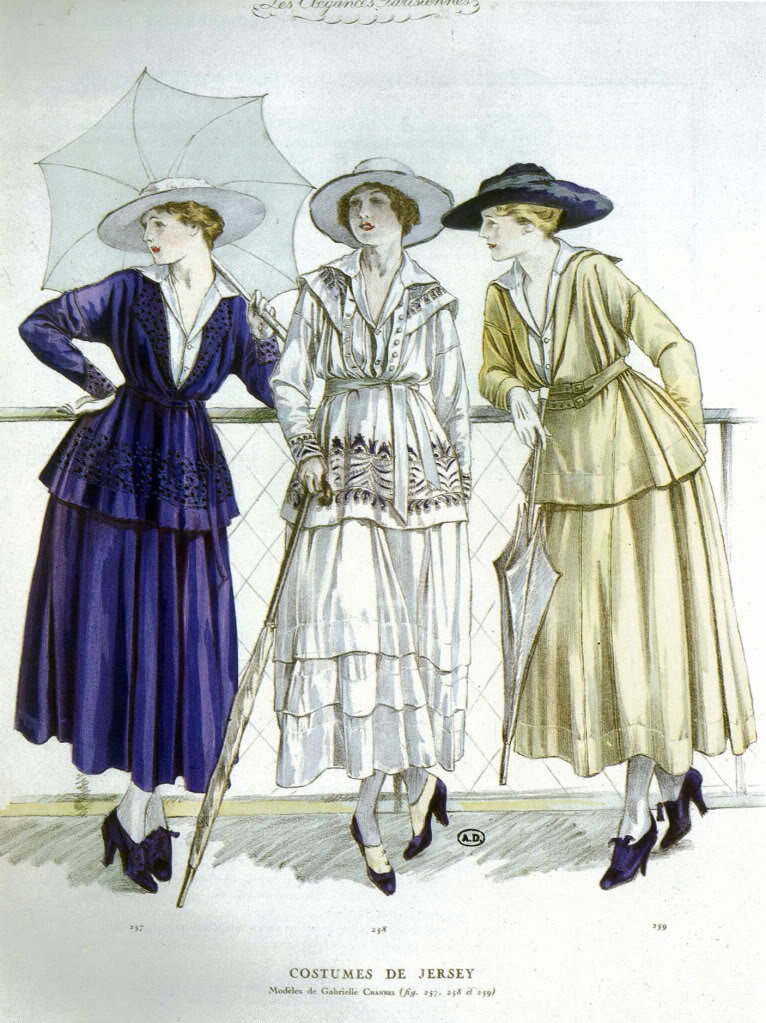
The illustration is more than a century old, yet the softly marked waist and full moving skirt still feel recognisably CHANEL.
The fabric did not remove shape; it changed how shape was created. Proportion, trim and a belt replaced stiffness.
Jersey never remained trapped in the house’s early history. In the Fall-Winter 2012/13 ready-to-wear show, long jersey dresses appeared with a fluid line that moved closely with the body.
Seen on the runway, the contrast is clear: the material is soft, but the silhouette is deliberate. The result is neither sportswear nor formal tailoring alone.
A jersey jacket can feel closer to a cardigan than a rigid blazer, yet thoughtful seams, trim and buttons keep it polished. A jersey dress uses the fabric’s drape to create a long, clean line without looking severe.
The name jersey does not guarantee stretch. Wool, silk and cotton jerseys differ, and lining or construction can change the feel completely. Measurements and the fibre label still matter when choosing a pre-owned piece.
For styling, let the fabric do the work. A jersey jacket with denim or simple trousers keeps its ease; a dress can move from daytime flats to jewellery and heels without losing its calm line.
For wardrobes that cross seasons and occasions, jersey offers a useful kind of versatility: the line stays polished while styling can remain simple.
The pieces long-time CHANEL clients wear most are not always the loudest ones.
A jacket or dress that feels easy enough for real life can become the quiet favourite in a wardrobe.
CHANEL JERSEY
Explore CHANEL Jersey
View the current selection of CHANEL jersey dresses, jackets, cardigans and knitwear.
View CHANEL Jersey PiecesRelated items for international customers
0 Item(s)